
Mining Rig Basics
Introduction
In this section, we’ll provide a comprehensive guide to Bitcoin mining rigs, or ASICs (Application Specific Integrated Circuits), designed specifically for efficient Bitcoin mining. You’ll gain insights into how these powerful machines are rated based on their hashrate and energy consumption, and discover the critical factors that influence their market value. We’ll delve into the various cooling technologies—air-cooled, immersion, and hydro—that help maintain these rigs under optimal conditions, ensuring maximum performance and longevity. Additionally, we’ll offer practical strategies for selecting the right ASIC miner based on your investment goals, risk tolerance, and market conditions. Finally, we’ll explore the differences between mining at home versus hosted mining, highlighting the benefits and challenges of each approach. Whether you’re a newcomer exploring Bitcoin mining or an experienced miner looking to optimize your setup, this section will equip you with the essential knowledge to make smart, informed decisions about your mining rig investments and the most suitable operational setup for your needs.
What You Need to Know About Bitcoin Mining Rigs
Bitcoin mining rigs are powerful, specialized computers known as ASICs (Application Specific Integrated Circuits), designed solely to mine Bitcoin with maximum efficiency. Leading manufacturers include Bitmain, MicroBT, and Canaan.
These rigs are rated based on two key metrics: Hashrate and Energy Consumption.
Hashrate: This measures the rig's computational power, typically in terahashes per second (TH/s). For example, the Bitmain S21 Pro operates at 234 TH/s. The higher the hashrate, the more chances a rig has to successfully mine Bitcoin.
Energy Consumption: This is the amount of electrical power the rig uses, measured in watts. The Bitmain S21 Pro consumes 3,510 watts—about the same power usage as ten household refrigerators.
One crucial measure of a mining rig's performance is its Efficiency, often expressed as watts per terahash (W/T). This metric tells you how much energy the rig needs to generate one terahash of computing power. For the Bitmain S21 Pro, the efficiency is 15 W/T. The lower the W/T, the more energy-efficient the rig is, meaning it uses less electricity to achieve the same level of performance, which can significantly impact profitability.
Mining rigs are also noisy, with the Bitmain S21 Pro producing around 76 decibels, similar to the sound of a loud vacuum cleaner. Additionally, these rigs generate significant heat, with the S21 Pro emitting approximately 11,935 BTUs per hour, more than twice the heat output of a standard space heater.
For more detailed information and images of different mining rigs Mining Rigs.
Mining Rigs have asset value
The market price of an ASIC mining rig is closely tied to the price of Bitcoin. As the price of Bitcoin rises, the demand for mining rigs typically increases, driving up their prices. This is because higher Bitcoin prices make mining more profitable, attracting more participants to the network. Conversely, when Bitcoin prices drop, the demand for ASICs may decrease, leading to lower market prices for the rigs.
In addition to the Bitcoin price, other critical factors influence the market value of an ASIC. One of the most important is the hashrate: the number of hashes the ASIC can compute per second. A higher hashrate indicates a more powerful machine capable of solving more cryptographic puzzles, thus increasing the chances of earning Bitcoin rewards.
Another key factor is the energy efficiency of the ASIC, which is determined by the number of energy units (usually measured in watts) consumed to produce each hash. ASICs that can generate more hashes per unit of energy are more efficient, making them more desirable and valuable in the market. Energy efficiency is crucial because electricity costs are one of the largest ongoing expenses in mining operations. Miners are often willing to pay a premium for ASICs that offer a better balance between hashrate and energy consumption, as these rigs can lower operating costs and increase profitability.
Ultimately, the market price of an ASIC is influenced by a combination of Bitcoin's market performance, the rig's computational power, and its energy efficiency. These factors together determine how much a miner is willing to invest in hardware to maximize their returns.
You can see the historical trading price for ASICs on the Marketplace.
Types of mining rigs (different types of ASICs)
The ASIC manufacturing industry is primarily dominated by two major players: Bitmain and MicroBT. Bitmain is known for its "Antminer" series, while MicroBT produces the "Whatsminer" line.
Both companies typically release new ASIC models on a similar schedule, with specs that are often closely matched. Choosing between Antminers and Whatsminers often comes down to individual preferences. Antminers are generally priced slightly lower, making them an attractive option for those looking to minimize upfront costs. On the other hand, Whatsminers are reputed for their physical durability, which can justify their somewhat higher price point.
New ASIC models are usually launched on a four-year cycle, timed with Bitcoin halvings. For instance, Bitmain released the Antminer S9 in 2016, the S19 in 2020, and the S21 in 2024. While both Bitmain and MicroBT may introduce mid-cycle models with minor improvements, the most significant upgrades typically align with these four-year intervals.
Cooling Technologies for ASIC Mining: Air-Cooled, Immersion, and Hydro
ASICs, due to their high energy consumption and continuous 24/7 operation, generate significant heat. Effective cooling solutions are essential to maintain optimal performance and prevent damage. Here’s an overview of the main cooling technologies used in mining:
Air-Cooled Machines
Air-cooled ASICs are the most commonly used due to their lower upfront costs. Both the machines themselves and the infrastructure required to operate them are more affordable compared to other cooling methods. Air-cooled systems use fans to dissipate heat, making them a straightforward and cost-effective choice for many miners. However, they may be less efficient in extremely hot environments or under heavy loads, leading to increased wear and tear over time.
Immersion Cooling
Immersion cooling involves submerging the ASICs in a specialized non-conductive oil that efficiently absorbs and dissipates heat. While immersion systems require a higher initial investment, they offer several key advantages over air-cooled systems:
Superior Cooling: Immersion cooling provides better temperature control, resulting in higher uptime and reduced physical wear on the hardware.
Noise Reduction: These systems are significantly quieter since there are no fans running at high speeds.
Increased Hashpower: Immersion-cooled ASICs can often be overclocked safely, providing more hashing power compared to their air-cooled counterparts.
Hydro Cooling
Hydro cooling uses water to manage the heat generated by ASICs. Similar to immersion cooling, hydro-cooled systems offer excellent temperature control and can enhance the performance and longevity of the mining hardware. However, they come with a slightly higher risk due to the potential for water leakage, which could cause damage to the machines if the infrastructure is compromised.
In summary, while air-cooled systems are popular for their lower costs, immersion and hydro cooling offer superior performance and durability, making them attractive options for miners looking to maximize their rigs' efficiency and lifespan. The choice between these technologies will depend on your budget and risk tolerance.
Strategies for Choosing Miners
When deciding which ASIC miner to invest in, it’s crucial to align your choice with your mining goals.
High Performance vs. Lower Performance ASICs: Making the Right Choice
Here are some key considerations to help you determine the best fit:
Return Denomination: Are you measuring your returns in Bitcoin (BTC) or US dollars (USD)?
Risk Exposure: Do you want to gain Bitcoin exposure without the volatility associated with buying and holding BTC directly?
Market Outlook: What are your expectations for Bitcoin’s price over the next 12 to 24 months?
Risk Tolerance: How much risk are you willing to take on with your mining investment?
Resale Value: Are you considering reselling your ASICs on the Blockware marketplace as part of your strategy?
Let's break down the characteristics of four different ASICs, and why a miner might choose each one based on their specific goals and market outlook.
Antminer S21 / S21 Pro (Latest-Generation, Low-Risk Choice)
The Antminer S21 and S21 Pro are among the most efficient ASICs in the market. Choosing the latest-generation hardware at the start of a new cycle is a proven strategy for successful Bitcoin mining. These machines offer the lowest BTC breakeven price, providing downside protection if Bitcoin’s price drops. In a bear market, these rigs remain profitable longer than less efficient models, as other miners are forced to unplug their machines, reducing mining difficulty and increasing your share of BTC rewards. While they require a higher upfront investment, their efficiency and durability make them a strong long-term choice, with solid resale value.
Click here for the current Marketplace inventory of Antminer S21 / S21 Pros.
Whatsminer M66s (Immersion-Cooled, High-Risk, High-Reward Play)
On paper, the Whatsminer M66s may seem slightly less appealing compared to the S21 Pro, with a higher upfront cost and lower energy efficiency. However, this immersion-cooled machine has unique advantages. It can be overclocked to achieve a higher hashrate, pushing its performance to around 330 TH/s. In bull markets, when Bitcoin's price is soaring, the increased hashpower of the M66s can lead to significantly higher profits, even if it’s less efficient. Additionally, the immersion cooling system makes the M66s more resilient to heat, reducing downtime and extending the machine's lifespan. If you’re looking to maximize profits during a bull market and are comfortable with the risks, the M66s is a powerful option.
Click here for the current Marketplace inventory of Whatsminer M66s.
Antminer S19K Pro / S19 XP (Balanced Efficiency and Cost)
Before the S21 series, the Antminer S19K Pro and S19 XP were the top performers in terms of energy efficiency. They still offer excellent performance, with energy efficiencies of 23 W/Th and 21.5 W/Th respectively. These ASICs are ideal if you want a profitable machine without the higher capital expenditure required for the latest models. If you’re bullish on Bitcoin’s price over the next 12 to 24 months, these rigs can deliver solid returns at a lower upfront cost, allowing you to achieve a faster ROI in a bullish scenario.
Click here for the current Marketplace inventory of Antminer S19K Pro / S19 XPs.
Antminer S19j Pro (High-Risk, Speculative Play)
The Antminer S19j Pro represents a more speculative, high-risk approach. Currently, these machines are not profitable under present market conditions, which has driven their prices down significantly. However, they offer substantial upside potential if Bitcoin enters a bull market. As Bitcoin’s price rises, these previously unprofitable ASICs can suddenly become valuable, much like an “out of the money” call option. During the 2021 bull run, older models like the Antminer S9 saw their resale values soar, even outperforming Bitcoin itself. If you’re willing to endure a period of negative returns and bet on a future market upswing, the S19j Pro could be a lucrative investment.
Click here for the current Marketplace inventory of Antminer S19j Pros
Conclusion
Each of these ASICs offers unique advantages depending on your mining strategy. Whether you're seeking the latest technology with low risk, a high-risk/high-reward option for bull markets, or a balanced approach that maximizes returns without a large upfront investment, it's crucial to understand the strengths and trade-offs of each model. By aligning your choice with your goals, market outlook, and risk tolerance, you can effectively optimize your mining operations and enhance your chances for long-term success.
Shutoff price / cost to mine 1 BTC
This metric goes by a few monikers:
“BTC Breakeven Price”
“BTC Shutoff Price”
“Cost to Mine 1 BTC”
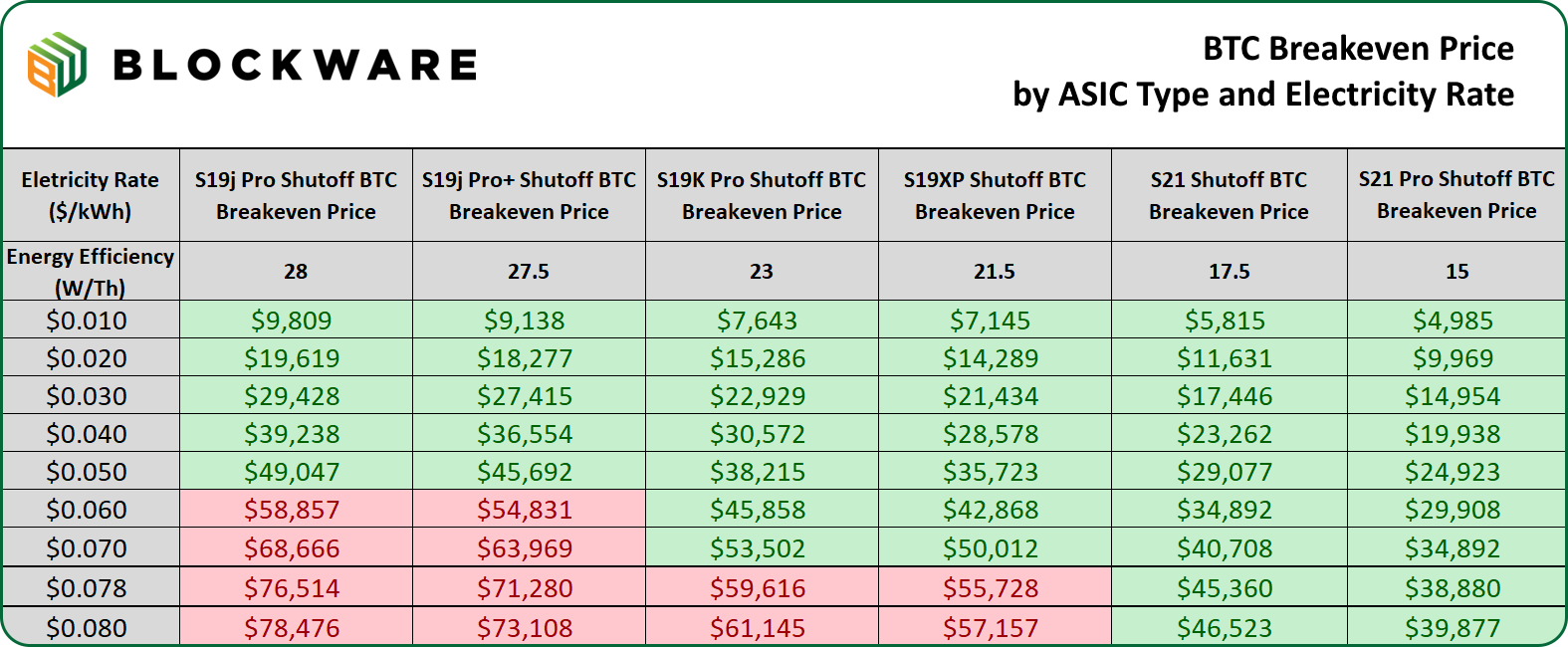
… naming conventions aside, this number tells you how much it will cost in electricity to mine 1 Bitcoin given a certain ASIC + electricity rate combination. Another way to think of it is “this is the price I am buying Bitcoin at.”
Mining is often described as a way to dollar-cost average into Bitcoin at a discount - this metric is reflective of that. The chart below shows the BTC breakeven prices for different machines based on the market dynamics as of 8/5/2024 (hashprice = $0.039/Th/Day).
Mining At Home
You can certainly choose to mine Bitcoin at home. Besides the fact that mining rigs are noisy and hot, and some other technical operational issues, the biggest issue for most people is the cost of energy.
Household Energy Prices
You are charged a price per kWh from your utility. As of February 2023, the average household rate in the US was $.23 per kWh.
Using the profitability calculation from before but replacing the energy cost with the $.23 average rate the miner becomes unprofitable.
As an example using the Bitmain S21 Pro:
Hashrate = 200 TH/s
Hashprice = $42 per PH/day (which is equivalent to $0.042 per TH/day)
Energy Consumption = 3510 watts (or 3.51 kW)
Energy Cost = $0.23 per kWh
Revenue = 200 TH/s x $0.042 TH/day = $8.4 per day.
Cost = 3.51 kW x $0.08 kWh x 24 hours = $19.38 per day.
Profit = $8.4 - $19.38 = -$10.89 per day.
Operating the Rig
Mining rigs require regular maintenance including cleaning to prevent dust buildup, which can cause overheating. You should use compressed air to clean fans and heat sinks at least once a month. You also need to keep an eye on key components like fans and power supplies. If you notice unusual noises or performance drops, replace the faulty parts promptly to avoid downtime.
Rig manufacturers often release firmware updates that improve performance. And it is helpful to use monitoring software to track your rig’s hashrate, temperature, and power usage. Set up alerts for any issues like overheating or connection problems so you can act quickly to fix them.
Hosted Mining
To explain hosted mining, let's imagine you're considering purchasing in an apartment complex, but instead of renting out apartments to people, you're "renting out" space for special machines called mining rigs or ASICs. These machines are like super-efficient workers who are really good at solving puzzles and earning you rewards in the form of Bitcoin.
The Apartment Complex (Hosting Facility)
Think of the hosting facility as the apartment complex. Instead of people living in the apartments, you're filling them with mining rigs. Each "apartment" is a space where a mining rig can be set up. Just like apartments need things like electricity, water, and internet, your mining rigs need a lot of electricity and cooling to keep them running efficiently. The hosting facility provides all of this.
The Mining Rigs (Tenants)
The mining rigs are like your tenants. They "live" in the apartment complex and work hard day and night to earn you bitcoin. The better the mining rig, the more Bitcoin it can potentially earn.
Why Pay to Have It Hosted?
Now, you might wonder, "Why would someone pay to have their mining rigs hosted in someone else’s apartment complex?"
Cost-Effective Electricity: Electricity is a major expense for mining. Hosting facilities often have access to cheaper electricity, which means your mining rigs can work at a lower cost. It’s like finding an apartment with utilities included at a discounted rate.
Professional Management: Just like you might hire a property manager to take care of an apartment complex, the hosting facility takes care of maintaining and monitoring the mining rigs. They handle things like ensuring the rigs are running smoothly, troubleshooting issues, and keeping them cool. This is especially valuable if you don’t want to worry about the day-to-day operations.
Scalability: If you were to set up all these mining rigs in your own home, you’d quickly run out of space, not to mention the noise and heat! A hosting facility has the infrastructure to support a large number of rigs doing the same thing, just like a big apartment complex can house many tenants.
Expertise: The people running the hosting facility are experts in mining. They know how to optimize the rigs for the best performance, which is like having a really good property manager who keeps your apartments in top shape and your tenants happy.
In this example, Blockware Marketplace offers Hosted Mining for your Rig. When you purchase a rig from a seller you also purchase Blockware’s Hosted Mining service to manage your rig and gain access to energy leveraging Blockware’s wholesale costs and all of the other benefits without having to manage it yourself.
Blockware’s Hosted Mining services can include:
Logistics of receiving and inventorying the mining rig
Physical setup, configuration, and optimization of the mining rig
Cost of electricity, often at rates lower than what individuals could access due to bulk purchasing or strategic location in areas with cheap electricity
Have purpose built buildings or containers managing the heat generated by the mining rig, ensuring it operates within safe temperature ranges
Provide routine maintenance on the rig, including cleaning, parts replacement, and firmware updates, to ensure optimal performance
Technical support to address any issues that arise, from hardware malfunctions to software glitches
The Blockware Mining Pool to participate in pooled mining efforts, which helps stabilize earnings by sharing rewards among multiple miners
Managed network connection for the mining rigs
Ensuring that the mining operation is secure from online threats, employing firewalls, encryption, and other cybersecurity measures
The Marketplace provides a dashboard to monitor the performance of the mining rig in real time, including metrics like hashrate, uptime, and profitability.
You choose the hosting contract length when you purchase a rig. Typically these are 1-3 years and rates vary depending on the hosting site and the contract length.
For example, Blockware Hosted Mining rates for our KY facility is presently $0.078/kWH or approximately $200/month.
Conclusion
This section has covered the key elements of Bitcoin mining rigs, focusing on their role as highly specialized machines that drive Bitcoin mining efficiency. We’ve examined the main factors that affect their value, such as hashrate, energy consumption, and overall efficiency, and explored the various cooling technologies that keep these machines running optimally. You’ve also learned about different strategies for choosing mining rigs, from the latest technology offering low-risk options to high-risk, high-reward machines suited for bullish market conditions. Additionally, we compared the pros and cons of mining at home versus hosted mining, emphasizing the considerations of cost, convenience, and scalability. With a better grasp of these concepts, you are now well-prepared to navigate the mining rig market, optimize your operations, and strategically decide whether home or hosted mining best aligns with your financial and operational goals in the world of Bitcoin mining.
Questions to Gauge Understanding
What are ASICs, and why are they specifically designed for Bitcoin mining?
How are Bitcoin mining rigs rated, and what do the terms "Hashrate" and "Energy Consumption" mean?
Why is energy efficiency, measured in watts per terahash (W/T), important in evaluating a mining rig's performance?
How do market factors like Bitcoin price and hashrate influence the value of a mining rig?
What are the main differences between air-cooled, immersion-cooled, and hydro-cooled ASICs?
How should you choose a mining rig based on your goals, risk tolerance, and market conditions?
What is the "BTC breakeven price," and why is it important for miners?
What is the purpose of hosted mining, and what are its advantages compared to mining at home?