
Advanced Topics
Introduction
In this section, we explore various strategies for managing Bitcoin (BTC) revenue generated through mining. We'll cover options such as holding all mined BTC, selling portions to cover hosting costs, or selling all BTC mined. Additionally, we examine the impact of Bitcoin halvings on mining profitability, the significance of understanding Bitcoin transaction fees, and the comparison between mining and purchasing BTC on the spot market. These insights will help you optimize your mining strategy and make informed decisions to maximize returns.
Analyzing the Relationship of Bitcoin Price & Hashrate
The relationship between Bitcoin’s price and hashrate plays a critical role in mining profitability. As Bitcoin’s price rises, more miners deploy rigs, increasing the hashrate. However, the lag in scaling mining infrastructure creates periods of higher profitability, especially during post-halving bull markets. When price growth outpaces hashrate expansion, miners benefit from increased earnings during these windows.
Key Trends in Bitcoin Cycles
• Bull Markets: Bitcoin price rises rapidly post-halving, while hashrate lags behind. This creates an environment of high profitability for miners.
• Bear Markets: As inefficient miners exit the market, hashrate stabilizes or declines. This leads to lower competition and opportunities for efficient miners to thrive.
• Halving Events: Reduced block rewards limit sell pressure, which can lead to sharp price increases. Miners experience a balance between reduced Bitcoin earnings per block and potential price appreciation, affecting their strategies.
The interplay between price and hashrate continues to shape mining strategies, with profitable windows emerging as miners respond to changing market conditions. Understanding this dynamic allows miners to better plan capital allocation, optimize timing for hardware deployment, and maximize returns in the cyclical nature of Bitcoin markets.
Blockware’s comprehensive Hashrate Report explores this dynamic in depth. For further insights, watch this video explanation.
Bitcoin Strategies (HODL ratio)
There are a few options for how to manage the BTC revenue generated through mining:
Hold All BTC Mined - Pay Hosting Out of Pocket
This is a great option for those with smaller fleets (1 to 5 machines) who desire to accumulate as much BTC as possible. If you use cash flows from your job or other businesses to pay your hosting bill, this will allow you to hold all of the BTC that you mine. Because mining allows you to acquire more BTC with that spend than you otherwise would acquire by buying spot BTC, this is the truest form of dollar cost averaging at a discount.
Sell BTC to Pay Hosting, Hold all the Rest
This is similar to strategy 1, but it is more practical for miners with larger fleet sizes. Selling just enough BTC to pay your hosting and then holding the rest is the most common practice for larger miners, and it is often how profitability is calculated.
Sell all BTC Mined
This is the least common strategy, but it could be appealing to those who do not have long-term conviction in the price of Bitcoin, or at the very least, expect a market downturn in the near future. Due to Bitcoin’s exceptional performance over the past decade, this strategy has greatly underperformed 1 & 2.
Bitcoin Halving
Halvings are pivotal events in the mining industry because they effectively reduce miner revenue by half overnight. This reduction in newly minted BTC also means that miners have fewer coins to sell on the open market, which can act as a positive catalyst for Bitcoin’s price — the most critical factor for mining profitability.
Historically, while the amount of BTC earned per block is halved, the price of Bitcoin has often increased significantly, sometimes more than doubling within the first year after a halving. This price increase can offset the reduction in block rewards, leading to a net-positive impact on miner profitability.
Click here for the Blockware Intelligence 2024 Halving Report.
Understanding Bitcoin Transaction Fees
In the Bitcoin network, transaction fees play a crucial role in compensating miners, especially as block subsidies (the reward for mining new blocks) decrease over time. Understanding how transaction fees work and how they affect mining profitability is essential for making informed decisions.
What Are Bitcoin Transaction Fees?
Every transaction on the Bitcoin network requires a fee to be paid to the miners who process and confirm the transaction. These fees are necessary because each block in the blockchain has a limited amount of space, and miners prioritize transactions with higher fees. This fee mechanism ensures that the network remains efficient and that miners are incentivized to maintain and secure the blockchain.
How Transaction Fees Affect Miner Revenue
As a miner, you earn revenue from two primary sources:
Block Subsidy: A fixed amount of new Bitcoin awarded for mining a new block. This amount halves approximately every four years in an event known as the "halving."
Transaction Fees: Additional income earned from processing transactions included in the block.
Over time, the block subsidy decreases, meaning transaction fees will become an increasingly important part of a miner’s revenue. This shift underscores the need to understand how transaction fees fluctuate and how they might impact overall profitability.
The Fee Market: An Auction for Block Space
Due to the limited block size (currently capped at 4 megabytes), not all transactions can be included in each block. This limitation creates a competitive market where users bid higher fees to ensure their transactions are processed quickly. During periods of high network activity, such as bull markets or when popular applications (like NFTs or “inscriptions”) create additional demand for block space, transaction fees can rise significantly.
For miners, this means that periods of high demand can result in substantial increases in fee revenue. Conversely, during quieter periods, when fewer transactions are taking place, fee income may decrease.
The Future of Mining Revenue: A Shift to Fee-Based Earnings
As the block subsidy continues to decline, the revenue from transaction fees will play an increasingly important role in sustaining the profitability of mining operations. This trend suggests a future where miners must rely more on transaction fees than on block subsidies.
It’s important to keep an eye on the fee market and understand how it influences your mining strategy. For example, during bull markets, higher transaction volumes and fees could significantly boost your earnings. Understanding these dynamics can help you optimize your mining operation to take advantage of periods of high demand and ensure your rigs remain profitable even as block subsidies decrease.
Mining vs. buying spot Bitcoin
When evaluating the decision between mining Bitcoin and buying it on the spot market, the data strongly suggests that mining can offer superior returns over time, particularly in the context of the upcoming 2024-2028 epoch.
Mining Bitcoin involves acquiring specialized hardware (ASICs) and covering ongoing electricity costs to secure the Bitcoin network. While this approach requires a significant initial investment and technical management, it has the potential to accumulate more Bitcoin than buying it outright. This study from Blockware Intelligence shows that a miner who purchased an S19 ASIC on May 12, 2020, and held all the Bitcoin they mined, accumulated approximately 0.669 BTC by January 11, 2022. In contrast, a person who used the same initial investment to buy Bitcoin on the spot market, and continued to dollar-cost average the equivalent of the miner’s electricity costs, only accumulated about 0.593 BTC over the same period.
This difference of 0.076 BTC (~$5,200 at current prices) highlights the advantage of mining over buying. The analysis shows that it took 609 days for the miner’s Bitcoin holdings to surpass those of the spot buyer. This comparison does not even account for the resale value of the mining hardware, which typically retain value even after significant use.
As the Bitcoin network continues to grow and halvings reduce the supply of new Bitcoin, the benefits of mining—especially when started early in a halving cycle—become even more pronounced.
In summary, while buying Bitcoin on the spot market is simpler and more straightforward, mining offers the potential for greater Bitcoin accumulation over time, making it an attractive option for those looking to maximize their Bitcoin holdings in the long run .
Comparing BTC with other Asset Classes
The "Purchasing Power Under a Bitcoin Standard" report by Blockware Intelligence explores how Bitcoin’s unparalleled monetary properties could lead to its adoption as the global standard for storing value. The report predicts that as Bitcoin continues to demonetize other asset classes like gold, real estate, equities, debt, and fiat money, its purchasing power will grow significantly. The analysis estimates that Bitcoin could eventually absorb a substantial portion of the monetary premium currently held by these assets, leading to a dramatic increase in its market cap and value.
Key insights include:
Bitcoin’s Monetary Premium: As fiat currencies continue to devalue, Bitcoin’s role as a store of value becomes increasingly important, potentially absorbing the monetary premium from other asset classes.
Demonetization of Other Assets: The report estimates that as Bitcoin replaces these traditional stores of value, its market cap could reach nearly $479 trillion, with a price per Bitcoin of approximately $22.8 million (in 2021 USD).
Long-term Growth: Even after this demonetization process, Bitcoin’s purchasing power is expected to continue growing in line with global productivity increases, rewarding savers and reshaping the investment landscape.
For a more detailed analysis and projections, click here to read the full report.
Advanced Bitcoin Mining Metrics
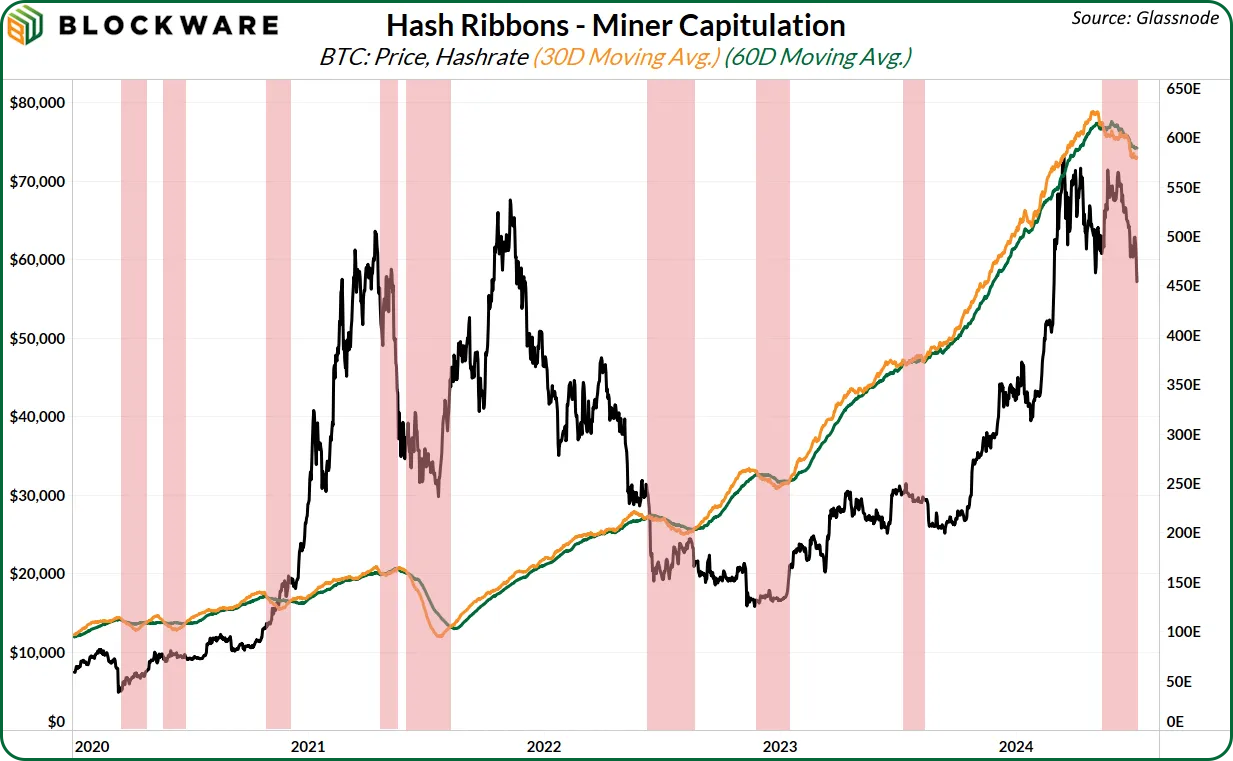
Hash Ribbon
An excess of unprofitable miners means heightened sell-pressure on BTC (these miners are selling most or all of the BTC they mine to cover operating expenses). The forced capitulation from these miners means a relief in sell-pressure, which has historically created local bottoms.
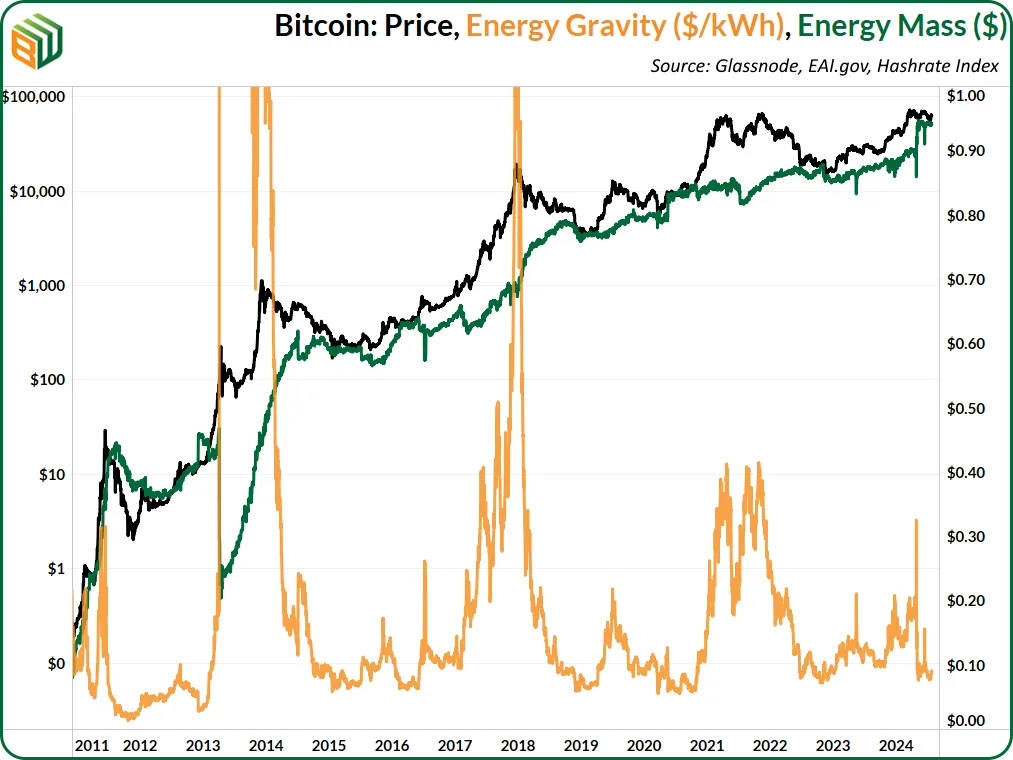
Energy Gravity
At a typical hosting rate today, new-gen Bitcoin ASICs require ~$50,500 worth of energy to produce 1 BTC (green line).When it costs roughly the same amount in energy to mine 1 BTC as it does to buy 1 BTC, that's usually a sign that BTC is extremely undervalued.
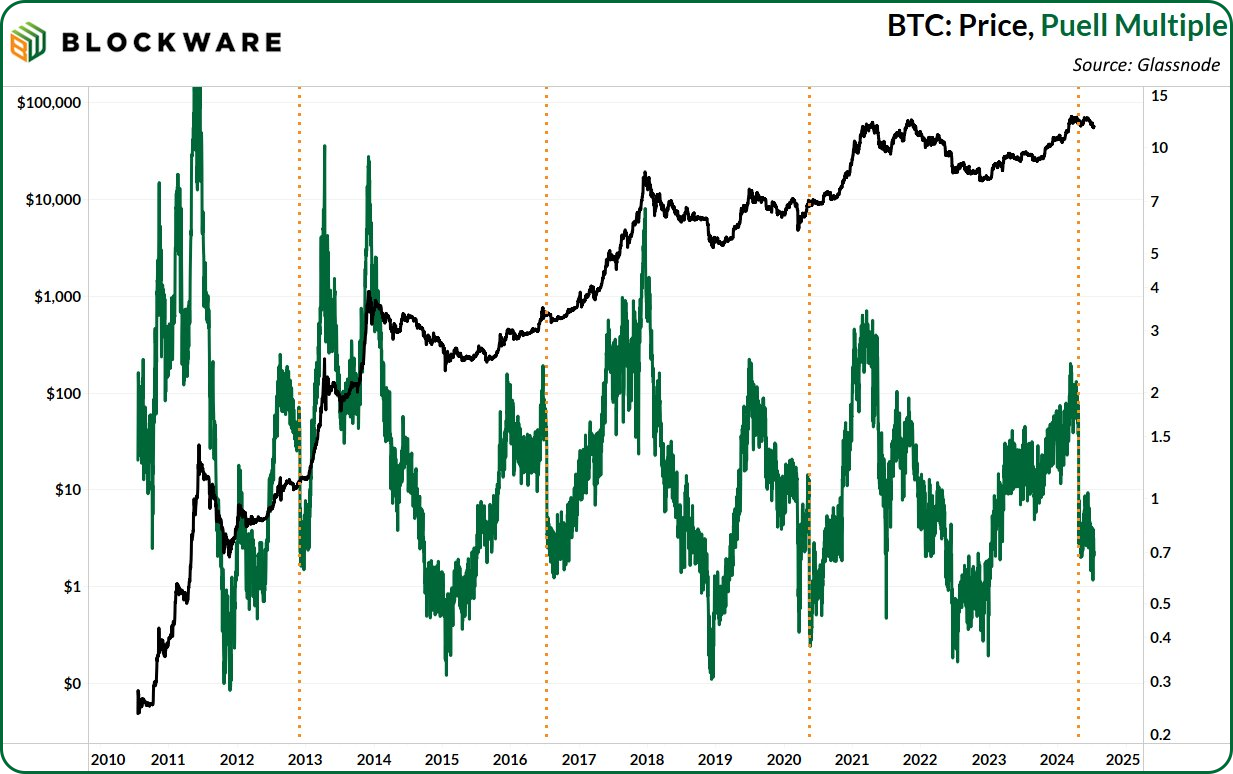
Puell Multiple
The Puell Multiple is calculated by dividing the daily BTC issuance in dollar terms by its 365-day moving average. This effectively shows the amount of potential miner-induced sell-pressure on the market relative to the past year. PM made lows after each of the past two halvings prior to price making an exponential move upwards. PM is at its lowest level since January 2023 and appears to be forming a bottom, providing a bullish indicator for price action going forward.
Future of Bitcoin mining
As the block subsidy continues to decrease, the transaction fee market will become increasingly vital for sustaining Bitcoin mining operations. For miners to remain profitable, transaction fees will need to rise, especially as the block reward diminishes. This evolution could lead to a more competitive fee market, where users prioritize quick transaction confirmations by offering higher fees. In such a scenario, miners would focus on processing high-fee transactions, creating a lucrative revenue stream. Additionally, as Bitcoin adoption grows and network activity increases, the overall volume of transactions could bolster fee income, compensating for the reduced block subsidy. This dynamic would encourage continued investment in mining infrastructure, ensuring the security and resilience of the Bitcoin network.
As transaction fees become the primary source of revenue for Bitcoin miners, the types of transactions included in blocks could diversify, reflecting broader use cases beyond simple payments. High-value, time-sensitive transactions, such as large financial transfers or trading on decentralized exchanges, may consistently offer higher fees to ensure quick processing. The recent Ordinals phenomenon, where digital artifacts are inscribed directly onto the Bitcoin blockchain, represents another example. These inscriptions have driven up transaction fees as users compete for limited block space to mint unique digital collectibles, further illustrating how varied and lucrative the transaction fee market could become for miners.
Bitcoin Mining and Taxes
When engaging in Bitcoin mining, there are several tax implications to consider, recognizing that this is not professional tax advice. Mining rigs, such as ASICs, may be treated as capital assets and could be depreciated over time. This depreciation can potentially reduce taxable income, as the cost of the equipment is spread out over its useful life. Depreciating these assets might allow miners to offset some of their operational costs, leading to tax benefits.
Additionally, Bitcoin earned from mining is typically considered income at the time of receipt and is taxed accordingly. This income could be subject to self-employment tax if mining is conducted as a business. As the value of Bitcoin fluctuates, any subsequent sale of mined Bitcoin could trigger capital gains tax, depending on the holding period and market conditions. It’s essential for miners to keep detailed records of their mining activities, including the fair market value of Bitcoin at the time it was mined, to accurately report income and any potential capital gains.
Contact your Tax Advisor
It's important to note that the tax implications of Bitcoin mining can be complex and vary depending on your specific circumstances. For authoritative guidance tailored to your situation, it's strongly recommended that you consult with a qualified tax advisor. They can provide expert advice on how to properly account for your mining activities, including the potential for asset depreciation and the reporting of mining income, ensuring compliance with all applicable tax laws.
Marketplace Tools to Support Taxes
The Marketplace offers features to assist with tax-related activities. You can easily download your wallet transactions as a CSV file from the Wallet tab, and your Marketplace transactions can also be exported as a CSV file from the Transactions tab. These tools provide a convenient way to organize and review your financial data for tax reporting purposes.
Conclusion
This section provided an overview of key strategies for managing BTC revenue from mining, highlighting the pros and cons of holding or selling mined BTC. We discussed the implications of Bitcoin halvings and the significance of transaction fees as the block subsidy decreases. Additionally, we explored the potential long-term advantages of mining over buying spot Bitcoin, considering factors like resale value and potential returns. These insights equip miners with the knowledge to optimize their strategies based on market conditions and personal goals.
Questions to Gauge Understanding
1. What are the advantages of holding all the BTC mined and paying hosting costs out of pocket?
2. Why might larger miners prefer to sell a portion of BTC to cover hosting costs while holding the rest?
3. How do Bitcoin halvings impact miner profitability, and what has historically happened to Bitcoin's price post-halving?
4. How do Bitcoin transaction fees factor into miner revenue, especially as block subsidies decrease?
5. What are the potential advantages of mining Bitcoin versus buying it on the spot market?
6. How does Bitcoin compare to other asset classes in terms of purchasing power?
7. What role do advanced mining metrics like the Hash Ribbon and Puell Multiple play in analyzing Bitcoin mining profitability?
8. How is the future of Bitcoin mining expected to shift with the decreasing block subsidy and rising transaction fees?
9. What are the tax implications of Bitcoin mining, and why is it essential to consult a tax advisor?